
MiniMax Music 3.0 vs 2.0: Quick Verdict
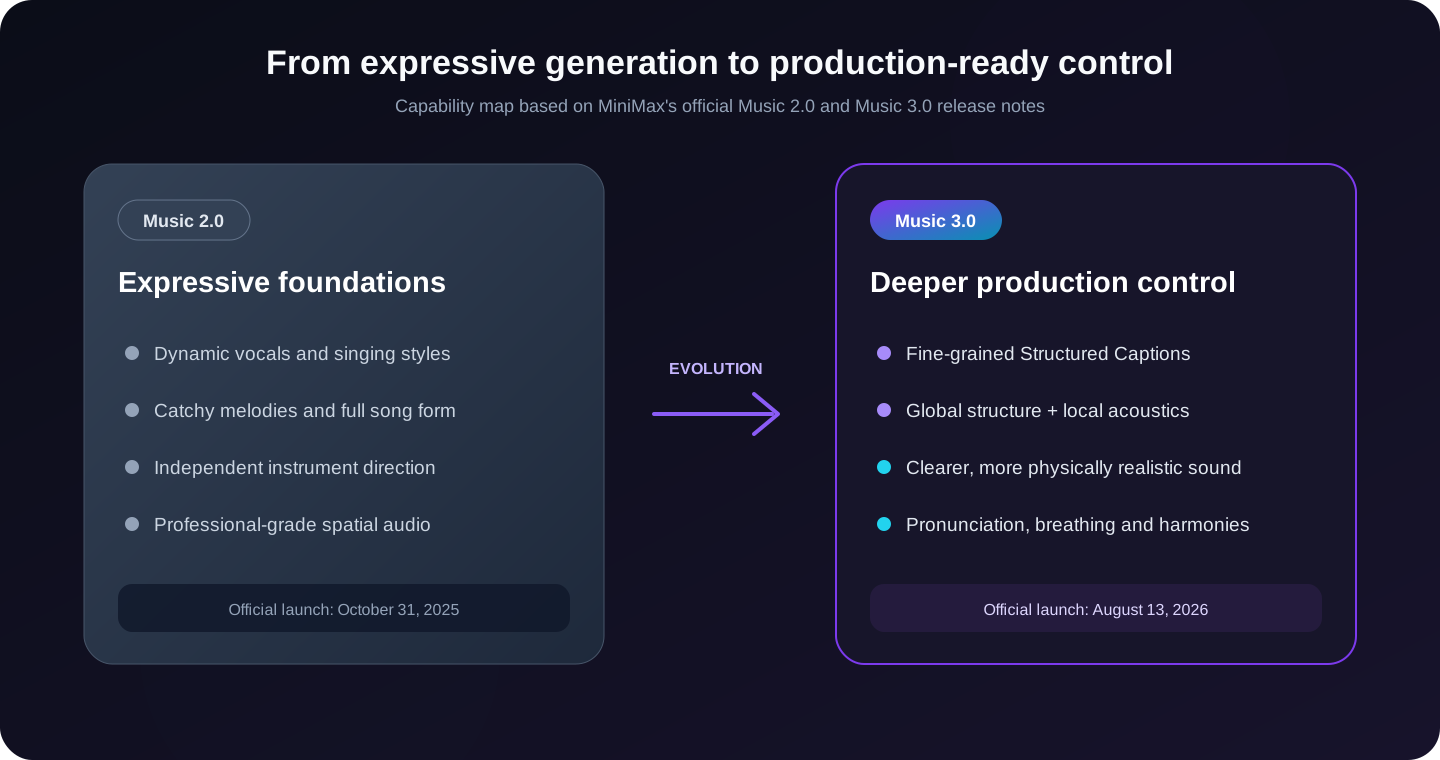
Music 2.0 established a strong expressive foundation. Music 3.0 redesigns the path from creative instruction to final audio so that a complete song can hold onto more of the original brief.
Music 2.0
Expressive generation foundation
Officially launched around dynamic vocal performance, diverse singing styles, memorable melodies, instrument-level direction, complete song forms, and upgraded spatial audio.
Music 3.0
Production-ready creative control
Adds fine-grained Structured Captions, a Global–Local Hybrid-LM, a redesigned synthesis stack, clearer mixes, more physically coherent instruments, and more natural vocal rendering.
What Changed from Music 2.0 to Music 3.0?
The official releases show an evolution in system depth, not a replacement of every earlier capability. Music 3.0 builds on the expressive goals of 2.0 and adds more explicit control over how those ideas develop across a full song.
Intent
From broad prompt control to fine-grained descriptions of emotion, arrangement, vocals, and production over time.
Structure
From complete verse–chorus–bridge forms to global song context coordinated with local acoustic detail.
Rendering
From professional-grade spatial audio to a redesigned flow-based stack targeting clearer and more balanced sound.
Vocals
From expressive human-like timbre to greater attention to pronunciation, breathing, artifacts, effects, and harmonies.
Official Feature Comparison Table
The wording below is deliberately conservative. It reflects capabilities described by MiniMax rather than assigning subjective scores or claiming tests we did not run.
| Category | MiniMax Music 2.0 | MiniMax Music 3.0 |
|---|---|---|
| Official positioning | An expressive music model focused on dynamic vocals, memorable melodies, instrument control, and professional-grade audio. | A next-generation, open-weights, production-ready model focused on realizing a coherent creative vision from intent through final rendering. |
| Complete-song length | Up to five minutes, with verses, choruses, and bridges. | Up to five minutes, with long-range structure maintained by global and local modeling. |
| Creative direction | Prompts can direct style, emotion, vocal timbre, singing technique, and instruments. | Structured Captions represent genre, tempo, key, emotion, instrumentation, vocals, arrangement changes, and production character over time. |
| Song structure | Generates logically complete songs with recognizable verse, chorus, and bridge sections. | Uses lyric section tags plus fine-grained arrangement descriptions to control how emotion, instruments, and vocals develop by section. |
| Vocals | Human-like timbre, varied singing techniques, emotional phrasing, duets, and a cappella examples. | Targets fewer high-frequency artifacts and improves melody, pronunciation, breathing, vocal effects, and layered harmonies. |
| Instruments | Supports independent instrument direction and layered arrangements with a natural groove. | Adds clearer instrument roles, stronger physical coherence, and more precise techniques such as glissando and legato. |
| Audio rendering | Upgraded vocal texture and spatial presence for a more immersive result. | Designed for a more open, clear, and balanced mix with less congestion and muddiness, using flow matching and a music-trained Flow-VAE. |
| Architecture disclosed | The launch article describes capabilities, but not a full technical architecture. | MiniMax documents the tokenizer, Global–Local Hybrid-LM, hidden-state fusion, flow matching, and Flow-VAE synthesis stack. |
| Open weights | Not announced on the official Music 2.0 launch page. | Released and officially described as open weights. |
Creative Intent and Prompt Control
Music 2.0 already supported meaningful prompt control. Music 3.0 makes the representation of that direction more detailed and more temporal.
Music 2.0's official examples emphasize controlling vocal timbre, singing style, emotional delivery, genre, and the way instruments enter an arrangement. That was already much more than a simple genre selector.
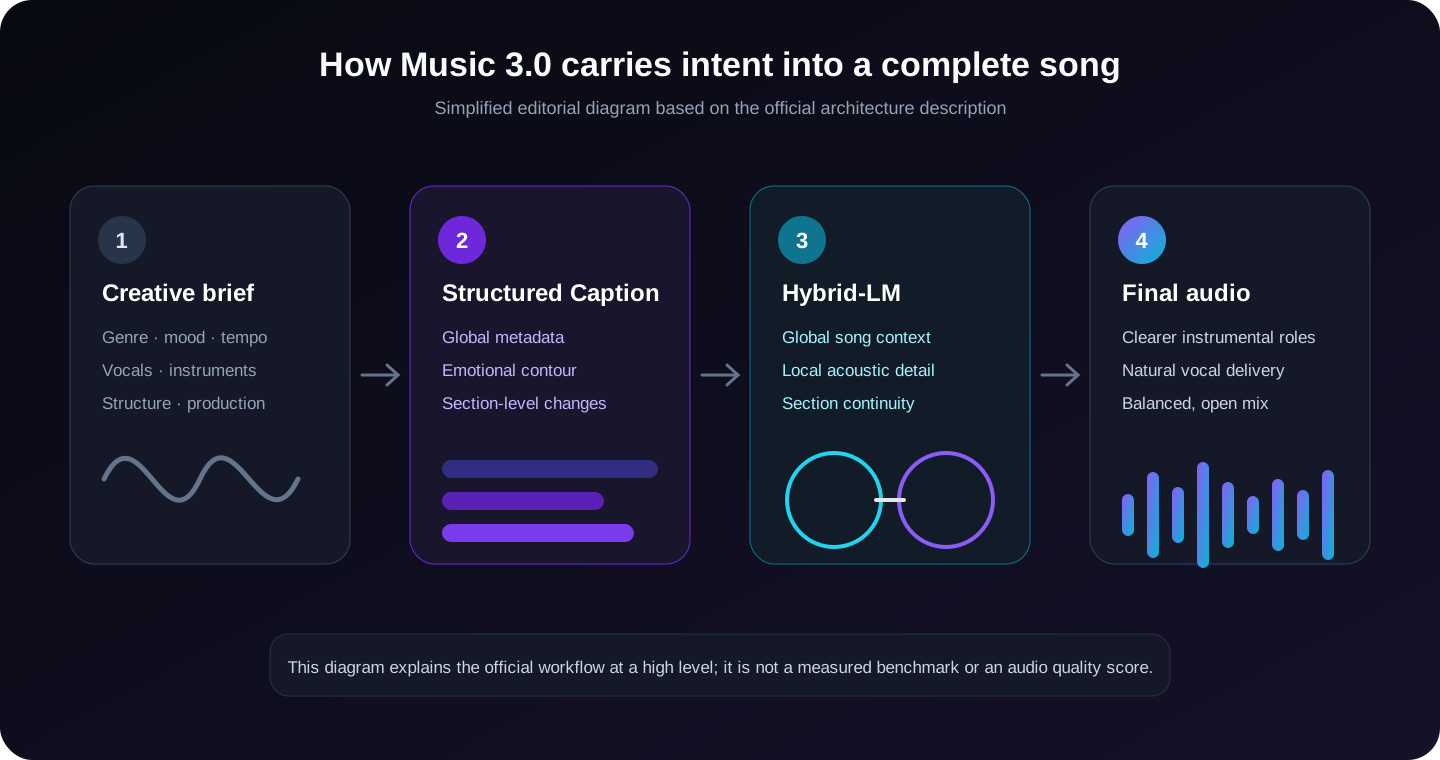
Music 3.0 introduces Structured Captions. MiniMax says these descriptions can include genre, tempo, time signature, key, use case, production character, emotional contour, instrument entry and exit, groove, low-end energy, vocal delivery, harmony, and effects.
The official Prompt Enhancement System can expand a simple description into a more complete musical instruction. This is designed to give non-specialists more precise control; the prompt guide shows how to write that direction without requiring professional arrangement terminology.
Full-Song Structure and Coherence
Both generations are described as capable of songs up to five minutes. The difference is how the newer model is designed to hold the song together.
Music 2.0
Complete, recognizable song form
MiniMax describes Music 2.0 as producing structurally complete songs with clear logic across verses, choruses, and bridges, while creating catchy melodies and layered arrangements.
Music 3.0
Macrostructure plus local detail
Section tags define the song's macrostructure, while the Structured Caption describes changes in emotion, instrumentation, rhythm, vocal delivery, and space. The 8B Global LLM models song-level context and the 0.6B Local LLM predicts within-frame acoustic detail.
Instrument Detail and Audio Quality
MiniMax presents both releases as audio-quality upgrades, but Music 3.0 provides a more detailed account of how its rendering system targets clarity and realism.
Clearer mixes
Music 3.0 is designed to produce more open, clear, and balanced mixes with less congestion and muddiness.
Distinct instrument roles
The official release highlights clearer separation, low-end impact without masking, and fine detail in dense arrangements.
Physical performance detail
Music 3.0 specifically cites more authentic techniques such as glissando and legato, plus improved string attack, bowing, drums, and bass.
Music 2.0's official release also emphasizes enhanced vocal texture, instrument spatial presence, and an immersive professional-grade experience. The distinction here is not that 2.0 lacked quality; it is that 3.0 describes a redesigned tokenizer-to-synthesis pipeline and more specific rendering goals.
Vocal Generation: Expression vs Rendering Detail
Music 2.0's launch centered heavily on performance variety. Music 3.0 keeps that expressive goal and puts more attention on the acoustic details that can reveal synthetic vocals.
Music 2.0 vocal strengths
- Human-like vocal timbre
- Diverse singing techniques and emotional styles
- Prompt-directed vocal identity and style changes
- Official duet and a cappella examples
Music 3.0 vocal upgrades
- Reduced high-frequency digital artifacts
- More control over melody and pronunciation
- More natural breathing and rhythmic delivery
- Detailed vocal timbre, falsetto, breathiness, harmony, delay, and Auto-Tune descriptions
When the decision is to create a new track from an idea rather than preserve an existing integration, start with the AI song generator workflow.
Which Version Fits Your Workflow?
For most people starting today, Music 3.0 is the straightforward choice. There are still practical reasons to keep a stable older integration while testing the migration.
Starting a new production workflow
The newer model is the clearer default when you want more detailed creative direction, stronger full-song coherence, and the latest rendering system.
Maintaining an existing Music 2.0 pipeline
Keep a proven 2.0 workflow when consistency with earlier outputs or an established integration matters more than adopting the newest model immediately.
Detailed arrangement and emotional arcs
Structured Captions and section-level descriptions make 3.0 the better-documented choice for tracking changes across verses, choruses, bridges, solos, and outros.
Studying an open music model
Music 3.0 is the version MiniMax released with open weights and a public explanation of its main architecture components.
Method, Sources, and Disclosure
This page compares official capability descriptions. It does not present invented listening scores, speed claims, pricing claims, or a controlled A/B audio test.
Primary source
Music 3.0 official release
MiniMax Research, published August 13, 2026.
Primary source
Music 2.0 official release
MiniMax News, published October 31, 2025.
Technical source
Music 3.0 open model page
Official MiniMaxAI model files, limitations, and usage notes.
Frequently Asked Questions
Is MiniMax Music 3.0 better than Music 2.0?
Music 3.0 is the newer model and MiniMax describes it as an upgrade in creative-intent understanding, arrangement completeness, audio clarity, instrumental realism, and natural vocal rendering. Music 2.0 remains important as the earlier generation that established dynamic vocals, memorable melodies, instrument control, and complete songs up to five minutes.
Can both Music 2.0 and Music 3.0 generate complete songs?
Yes. MiniMax's official release pages state that both generations can create complete songs up to five minutes. Music 3.0 adds a more explicit system for maintaining structure and acoustic detail across that duration.
What is the biggest Music 3.0 upgrade?
The most important change is not one isolated feature. Music 3.0 connects fine-grained creative descriptions, long-range song modeling, local acoustic detail, and a redesigned rendering stack so the result can stay closer to the intended musical direction across a complete song.
Does Music 3.0 support section labels in lyrics?
Yes. The official Music 3.0 release describes section tags including intro, verse, pre-chorus, chorus, bridge, instrumental, solo, and outro. These tags define macrostructure while the Structured Caption describes how the performance changes through the song.
Is MiniMax Music 3.0 open weights?
Yes. MiniMax officially introduced Music 3.0 as an open-weights model and provides its model files and usage information through the official MiniMaxAI repository and model page.
Are the images on this page audio benchmark results?
No. They are original editorial diagrams that summarize the official release information. This page does not claim a controlled listening test or assign unsupported quality scores.
Try the newer generation
Create a complete track with MiniMax Music 3.0
Bring a creative brief and your lyrics, or choose an instrumental workflow. Describe the sound, structure, vocal character, and production direction you want to hear.